Blog Topics...

3D plotting (1) Academic Life (2) ACE (18) Adaptive Behavior (2) Agglomeration (1) Aggregation Problems (1) Asset Pricing (1) Asymmetric Information (2) Behavioral Economics (1) Breakfast (4) Business Cycles (8) Business Theory (4) China (1) Cities (2) Clustering (1) Collective Intelligence (1) Community Structure (1) Complex Systems (42) Computational Complexity (1) Consumption (1) Contracting (1) Credit constraints (1) Credit Cycles (6) Daydreaming (2) Decision Making (1) Deflation (1) Diffusion (2) Disequilibrium Dynamics (6) DSGE (3) Dynamic Programming (6) Dynamical Systems (9) Econometrics (2) Economic Growth (5) Economic Policy (5) Economic Theory (1) Education (4) Emacs (1) Ergodic Theory (6) Euro Zone (1) Evolutionary Biology (1) EVT (1) Externalities (1) Finance (29) Fitness (6) Game Theory (3) General Equilibrium (8) Geopolitics (1) GitHub (1) Graph of the Day (11) Greatest Hits (1) Healthcare Economics (1) Heterogenous Agent Models (2) Heteroskedasticity (1) HFT (1) Housing Market (2) Income Inequality (2) Inflation (2) Institutions (2) Interesting reading material (2) IPython (1) IS-LM (1) Jerusalem (7) Keynes (1) Kronecker Graphs (3) Krussel-Smith (1) Labor Economics (1) Leverage (2) Liquidity (11) Logistics (6) Lucas Critique (2) Machine Learning (2) Macroeconomics (45) Macroprudential Regulation (1) Mathematics (23) matplotlib (10) Mayavi (1) Micro-foundations (10) Microeconomic of Banking (1) Modeling (8) Monetary Policy (4) Mountaineering (9) MSD (1) My Daily Show (3) NASA (1) Networks (46) Non-parametric Estimation (5) NumPy (2) Old Jaffa (9) Online Gaming (1) Optimal Growth (1) Oxford (4) Pakistan (1) Pandas (8) Penn World Tables (1) Physics (2) Pigouvian taxes (1) Politics (6) Power Laws (10) Prediction Markets (1) Prices (3) Prisoner's Dilemma (2) Producer Theory (2) Python (29) Quant (4) Quote of the Day (21) Ramsey model (1) Rational Expectations (1) RBC Models (2) Research Agenda (36) Santa Fe (6) SciPy (1) Shakshuka (1) Shiller (1) Social Dynamics (1) St. Andrews (1) Statistics (1) Stocks (2) Sugarscape (2) Summer Plans (2) Systemic Risk (13) Teaching (16) Theory of the Firm (4) Trade (4) Travel (3) Unemployment (9) Value iteration (2) Visualizations (1) wbdata (2) Web 2.0 (1) Yale (1)
Showing posts with label Unemployment. Show all posts

Wednesday, January 2, 2013

Graph of the Day

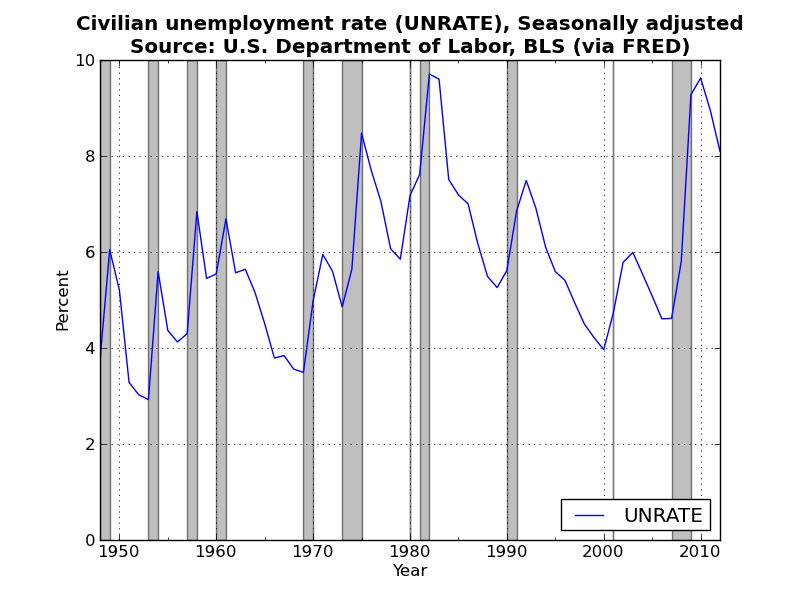
A busy day (actually trying to do a bit of my own research!)...so I just threw together a plot of the historical civilian unemployment rate using FRED data (similar to figure 1-3 from Mankiw's intermediate macroeconomics textbook).  Very boring I know, but tomorrow I promise something a bit more interesting!

If anyone can point me in the direction of the actual data that Mankiw uses to generate the graphs from his textbook I would be very grateful. I can't seem to find it! Code for the above is available on GitHub.

Saturday, March 12, 2011

Really interesting interview with BoE Governor Mervyn King...

Excellent, wide-ranging interview.  The following quote made me stop and think...
“The more I’ve thought about how labour markets work, the more I’ve realised that there are hardly any jobs whose tasks you can describe exactly. Nowadays, most jobs have the property that employees can choose to do them well or badly, so employers need to think about the long-term welfare of the staff not just pay today.”
Another nice comment more relevant to my current line of research:
“I wish I’d spoken out more forcefully about the build-up of leverage.”
Amen, brother...Amen.

Sunday, January 23, 2011

France v. U.S.: Employment...

Paul Krugman re-hashed an interesting post comparing a key employment stat (percent employment for 25-54 year-olds) for the U.S. and France.  I found the graphic particularly compelling, and thought I should reproduce it from the raw OECD data myself...

The first graph is my replication of Krugman's.  The graphic suggests that the idea, popular even amongst "well-informed" circles in the U.S., that job prospects in the U.S. are somehow generally superior to those in the "Old-World," is no longer true (France, of course, plays the stereotype of Old Europe).  The graphic might support that hypothesis for  the early 1980's through 2000, but things seemed to have changed dramatically over the last 10 years... 


It is important to note that Krugman expresses the employment percentages as:

(No. of employed persons ages 25-54) / (Total population ages 25-54)

I thought that it might be worthwhile to also look at the employment percentages for:

(No. of employed persons ages 25-54) / (Total labour force ages 25-54)

The difference is that, in this case, I am normalizing by the total labour force ages 25-54 (instead of the total population figure).  Why?  I thought there might be some funny things going on in the persons ages 25-54 who are not looking for work (i.e., included in total population count but not in the labour force count).  This graph is below...


I don't really have a good interpretation of the differences...but thought I would share the figures anyway.

Tuesday, December 14, 2010

Back to Python and Markov Chains...

So I am back to programming in Python and working my way through Economic Dynamics: Theory and Computation.  I am in the middle of Chapter 4 at the moment and have just written some basic code for simulating the Markov-switching model of unemployment from Hamilton (2005).  I highly recommend a read of the paper.  It is fairly short, contains a neat little model, and after reading it I felt like I had a greater understanding of the dynamics of unemployment and the business cycle...

I will continue to work on the code over the holidays, and will push my it out to github for others to use...after I get my github repository set up!

Wednesday, August 18, 2010

Even More Economics 101 by Brad DeLong...

Another must read for those of us teaching/tutoring intro macroeconomics...

Tuesday, July 27, 2010

Ezra Klein Channels Krugman (of March 2009!)...

Read Ezra Klein's blog post from yesterday...and then follow that up with Krugman vintage March, 2009.

Love him or hate him (and many of my conservative friends loathe him), his analysis of the unfolding economic crisis has been consistently superior, more prescient, and more data driven than that of his peers.

Tuesday, July 20, 2010

DeLong vs. Ferguson...

This post was prompted by two dueling op-ed pieces by Brad Delong and Niall Ferguson in today's Financial Times.  The two sides can be best summarised by their respective titles:
  • "It is far too soon tom end expansion," and
  • "Today's Keynesians have learnt nothing"
I am a big fan of the work of Hyman Minsky which figures prominently in DeLong's piece and I would highly recommend Minsky's "Stabilizing an Unstable Economy" to anyone interested in macroeconomics and financial crises.  Minsky's argument, which is aptly summarised by DeLong, is that in a recession (or depression) brought about by a financial crisis there is an excess demand for safe, risk-free financial assets.  This excess demand is then balanced by excess supply in the labor market (i.e., high levels of unemployment).  Given his diagnosis, Minsky's remedy is to have the government expand the supply of safe, risk-free financial assets by acting as the "lender of last resort." From a practical standpoint, this can be done in three ways:

1) Expand the money supply.  This is the monetarist's cure...
2) Create reserve deposits...
3) Further expand the supply of safe, risk-free government bonds by selling them and using the proceeds to buy risky private sector securities...

All of this rests on the implicit assumption that people view government issued and backed securities as safe and risk-free.  What happens if this is not the case? or perhaps more importantly, how can we tell if people are starting to alter their risk-free expectations concerning government securities?  DeLong argues that financial markets will send a strong signal (in the form of rising interest rates on government securities) when people have had enough expansionary policy, and that currently these markets are sending strong signals (in the form of falling interest rates) that additional expansionary policy is needed.

Ferguson's argument has a predictably more historical flavor, and compares today's economic environment with the economic environment leading up to the second World War.  See here, and here for substantive critiques of his argument.  In the end he arrives at the conclusion that the real debate is not between austerity policies and expansion policies, but between those policies that increase private-sector confidence and those that do not.

Now...if you believe that Minsky's diagnosis is correct, then policies whose sole purpose is aimed at boosting private sector confidence will not help very much (and could very well be counterproductive).  Increased private sector confidence is typically interpreted to mean increased private sector investment.  As such policies aimed at increasing private sector confidence are typically designed to induce private sector investment.  The reason that such policies will be ineffective is that a la Minsky, the excess demand is for safe, risk free assets and NOT for private sector securities (which are inherently risky).         

Thursday, July 8, 2010

To Extend, or Not to Extend...

If you are interested in the debate on whether or not to extend unemployment benefits I would recommend the following:
Needless to say, I found Chetty's argument for extending unemployment benefits to be much more compelling.

Labor Hoarding...

From Stumbling and Mumbling:
The OBR reckons (pdf) that private sector employment will grow by a net 1.95 million between 2010-11 and 2015-16, more than enough to offset public sector job cuts. I agree with Anthony and Sunny that this is unlikely, for three reasons.
1. It’s a lot by historic standards. The OBR’s forecast is for an 8.3% increase. Although this is less than the 9.7% rise we had in 1993-98 - after the last recession - it is above the 5.6% rise we saw in the five years to the peak in 2008Q1.

2. And there’s a big difference between those five years and the next. Companies could borrow freely then. But unless things change a lot, they’ll not be able to in the next five years.

3. This recession has differed in one respect (at least!) from the early 90s’ one. Back then, firms were quick to shed staff, and so had to re-hire quickly as the economy picked up. This time, though, employment has held up well relative to output: since Q1 2008, private sector GDP has fallen by around 6.6%, whilst employment has dropped just 4.1%.

This suggests many firms have been hoarding labour and under-employing people. Perhaps they’ve been loath to sack skilled workers for fear of not being able to re-hire in the upturn. But this in turn suggests that if the economy recovers, firms will react by using existing labour more intensively, rather than by hiring new staff.

Of course, it could be instead that employment has held up not because of labour hoarding, but because of an adverse productivity shock. But if this is the case, how can employment rise quickly without generating inflation?

These suspicions make me wonder about the OBR. Their forecasts look very much like they are heeding Montagu Norman's advice to a Bank of England economist: “Your job is not to tell us what we should do, but to explain to us why we’ve done what we have.”