Suppose large number of identical firms in a perfectly competitive industry with constant returns to scale (CRTS) Cobb-Douglas production functions: \[Y = F(K, L) = K^{\alpha}(AL)^{1 - \alpha}\] Output, Y, is a homogenous of degree one function of capital, K, labor, L, and technology, A, is labor augmenting.
Typically, we economists model firms as choosing demands for capital and labor in order to maximize profits while taking prices as given (i.e., unaffected by the decisions of the individual firm):\[\max_{K,L} \Pi = K^{\alpha}(AL)^{1 - \alpha} - (wL + rK)\] where the prices are $1, w, r$. Note that I am following convention in assuming that the price of the output good is the numeraire (i.e., normalized to 1) and thus the real wage, $w$, and the return to capital, $r$, are both relative prices expressed in terms of units of the output good.
The first order conditions (FOCs) of a typical firms maximization problem are \[\begin{align}\frac{\partial \Pi}{\partial K}=&0 \implies r = \alpha K^{\alpha-1}(AL)^{1 - \alpha} \label{MPK}\\
\frac{\partial \Pi}{\partial L}=&0 \implies w = (1 - \alpha) K^{\alpha}(AL)^{-\alpha}A \label{MPL}\end{align}\] Dividing $\ref{MPK}$ by $\ref{MPL}$ (and a bit of algebra) yields the following equation for the optimal capital/labor ratio: \[\frac{K}{L} = \left(\frac{\alpha}{1 - \alpha}\right)\left(\frac{w}{r}\right)\] The fact that, for a given set of prices $w$, $r$, the optimal choices of $K$ and $L$ are indeterminate (any ratio of $K$ and $L$ satisfying the above condition will do) implies that the optimal scale of the firm is also indeterminate.
How can I create a graphic that clearly demonstrates this property of the CRTS production function? I can start by fixing values for the wage and return to capital and then creating contour plots of the production frontier and the cost surface.
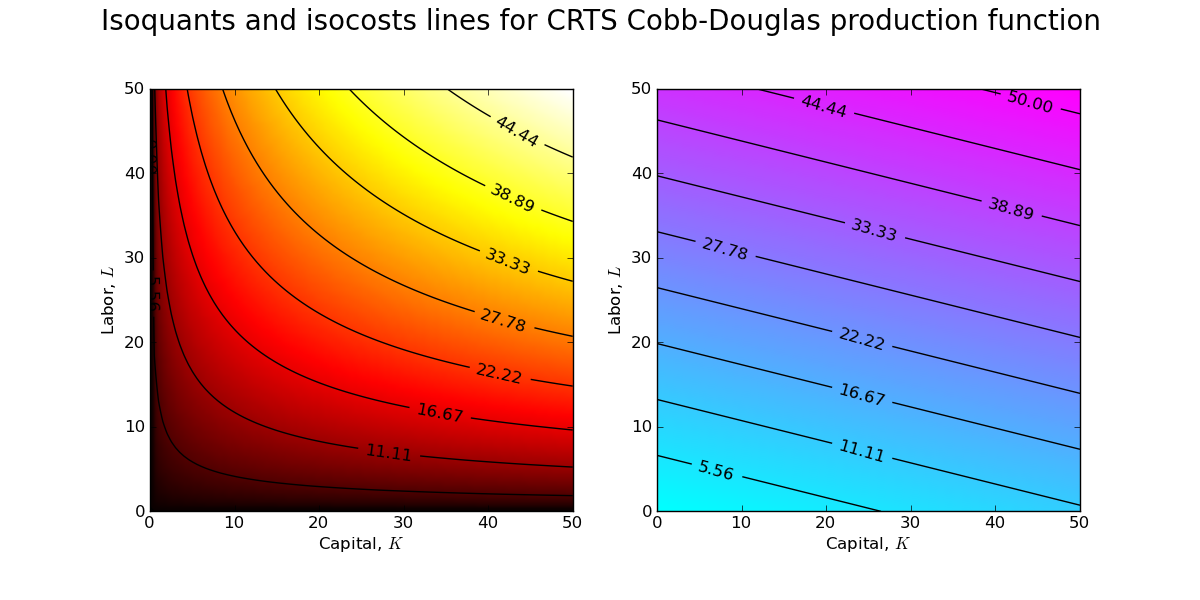
The above contour plots are drawn for $w\approx0.84$ and $r\approx0.21$ (which implies an optimal capital/labor ratio of 2:1). You should recognize the contour plot for the production surface (left) from a previous post. The contour plot of the cost surface (right) is a simple plane (which is why the isocost lines are lines and not curves!). Combining the contour plots allows one to see the set of tangency points between isoquants and isocosts.
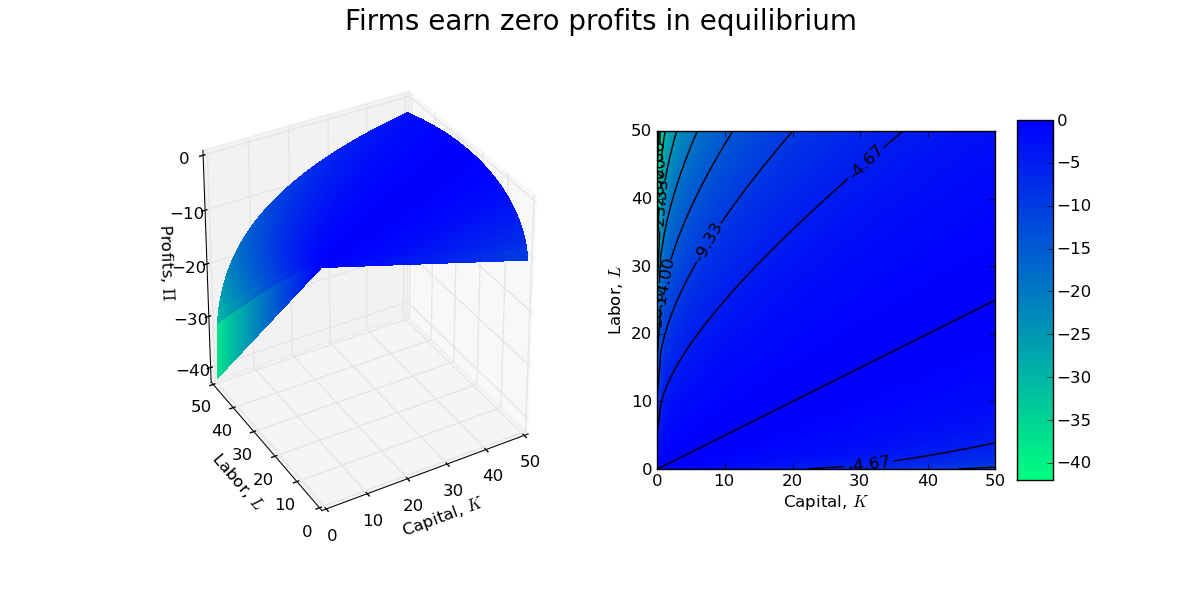
A firm manager is indifferent between each of these points of tangency, and thus the size/scale of the firm is indeterminate. Indeed, with CRTS a firm will earn zero profits at each of the tangency points in the above contour plot.
As usual, the code is available on GitHub.
Update: Installing MathJax on my blog to render mathematical equations was easy (just a quick cut and paste job).
Blog Topics...
3D plotting
(1)
Academic Life
(2)
ACE
(18)
Adaptive Behavior
(2)
Agglomeration
(1)
Aggregation Problems
(1)
Asset Pricing
(1)
Asymmetric Information
(2)
Behavioral Economics
(1)
Breakfast
(4)
Business Cycles
(8)
Business Theory
(4)
China
(1)
Cities
(2)
Clustering
(1)
Collective Intelligence
(1)
Community Structure
(1)
Complex Systems
(42)
Computational Complexity
(1)
Consumption
(1)
Contracting
(1)
Credit constraints
(1)
Credit Cycles
(6)
Daydreaming
(2)
Decision Making
(1)
Deflation
(1)
Diffusion
(2)
Disequilibrium Dynamics
(6)
DSGE
(3)
Dynamic Programming
(6)
Dynamical Systems
(9)
Econometrics
(2)
Economic Growth
(5)
Economic Policy
(5)
Economic Theory
(1)
Education
(4)
Emacs
(1)
Ergodic Theory
(6)
Euro Zone
(1)
Evolutionary Biology
(1)
EVT
(1)
Externalities
(1)
Finance
(29)
Fitness
(6)
Game Theory
(3)
General Equilibrium
(8)
Geopolitics
(1)
GitHub
(1)
Graph of the Day
(11)
Greatest Hits
(1)
Healthcare Economics
(1)
Heterogenous Agent Models
(2)
Heteroskedasticity
(1)
HFT
(1)
Housing Market
(2)
Income Inequality
(2)
Inflation
(2)
Institutions
(2)
Interesting reading material
(2)
IPython
(1)
IS-LM
(1)
Jerusalem
(7)
Keynes
(1)
Kronecker Graphs
(3)
Krussel-Smith
(1)
Labor Economics
(1)
Leverage
(2)
Liquidity
(11)
Logistics
(6)
Lucas Critique
(2)
Machine Learning
(2)
Macroeconomics
(45)
Macroprudential Regulation
(1)
Mathematics
(23)
matplotlib
(10)
Mayavi
(1)
Micro-foundations
(10)
Microeconomic of Banking
(1)
Modeling
(8)
Monetary Policy
(4)
Mountaineering
(9)
MSD
(1)
My Daily Show
(3)
NASA
(1)
Networks
(46)
Non-parametric Estimation
(5)
NumPy
(2)
Old Jaffa
(9)
Online Gaming
(1)
Optimal Growth
(1)
Oxford
(4)
Pakistan
(1)
Pandas
(8)
Penn World Tables
(1)
Physics
(2)
Pigouvian taxes
(1)
Politics
(6)
Power Laws
(10)
Prediction Markets
(1)
Prices
(3)
Prisoner's Dilemma
(2)
Producer Theory
(2)
Python
(29)
Quant
(4)
Quote of the Day
(21)
Ramsey model
(1)
Rational Expectations
(1)
RBC Models
(2)
Research Agenda
(36)
Santa Fe
(6)
SciPy
(1)
Shakshuka
(1)
Shiller
(1)
Social Dynamics
(1)
St. Andrews
(1)
Statistics
(1)
Stocks
(2)
Sugarscape
(2)
Summer Plans
(2)
Systemic Risk
(13)
Teaching
(16)
Theory of the Firm
(4)
Trade
(4)
Travel
(3)
Unemployment
(9)
Value iteration
(2)
Visualizations
(1)
wbdata
(2)
Web 2.0
(1)
Yale
(1)
Showing posts with label Theory of the Firm. Show all posts
Saturday, December 22, 2012
Friday, July 23, 2010
Asking About Prices, Again...
Due to popular demand, I thought that I would take some time to expound upon some of the interesting results from Alan Blinder's Asking About Prices: A New Approach to Understanding Price Stickiness.
First of all, why should we care about price stickiness? Chiefly because sluggish price adjustment (price stickiness) provides a mechanism through which monetary policy can affect the real economy.
The following theories of prices stickiness emerged from the results of Blinder's survey as winners: coordination failure, non-price competition, implicit contracts and cost-based pricing (it is worth noting that all of the theories that did well in the survey have a distinctly Keynesian flavor):
Non-Price Competition: This one is a bit more difficult to summarize...as such I will try to address it in a later blog post.
Implicit Contracts and Cost-Based Pricing: Though it did well in the survey, Okun's implicit contract theory is difficult to test. Okun's original idea was that firms would form these implicit contracts as a result of their desire to attract repeat customers and thus economize on search costs. Interestingly, firms in the survey with larger numbers of repeat customers did not rate this theory highly. Firms who rated this theory highly focused on the need to establish a general reputation for "fairness" or "fair-dealing." Now cost-based pricing only works as a theory of price stickiness if firms fail to react to anticipated increases in input prices (i.e., costs). Why would a firm not raise nominal prices if it sees nominal cost rises coming? Coordination failure and an unwillingness to antagonize customers perhaps (i.e., implicit contract theory)? But what about money illusion? Any implicit contracts that are optimal/rational would have to apply to relative prices (i.e. real prices). Thus there should be no money illusion...but Blinder's survey results clearly demonstrate that firms rarely pay attention to national inflation forecasts. Most real-world contracts are nominal. How to reconcile these two facts...perhaps if firms believe that customers suffer from money illusion, then frequently tinkering with nominal prices as part of an effort to stabilize real/relative prices might drive them off!
I really enjoyed reading this book. I think Blinder's contribution is significant and worthy of more notoriety than it seems to have attained. In fact I wonder if you could use the book to teach a graduate course (or part of one) in macro...
First of all, why should we care about price stickiness? Chiefly because sluggish price adjustment (price stickiness) provides a mechanism through which monetary policy can affect the real economy.
The following theories of prices stickiness emerged from the results of Blinder's survey as winners: coordination failure, non-price competition, implicit contracts and cost-based pricing (it is worth noting that all of the theories that did well in the survey have a distinctly Keynesian flavor):
- Coordination Failure: Firms hold back on price changes waiting for other firms to go first.
- Cost-Based Pricing: Price rises are delayed until costs rise, and these delays accumulate through multi-stage production process.
- Non-Price Competition: Firms vary non-price elements such as delivery lags, service, or quality.
- Implicit Contracts: Firms tacitly agree to stabilize prices, perhaps out of "fairness" to customers.
Non-Price Competition: This one is a bit more difficult to summarize...as such I will try to address it in a later blog post.
Implicit Contracts and Cost-Based Pricing: Though it did well in the survey, Okun's implicit contract theory is difficult to test. Okun's original idea was that firms would form these implicit contracts as a result of their desire to attract repeat customers and thus economize on search costs. Interestingly, firms in the survey with larger numbers of repeat customers did not rate this theory highly. Firms who rated this theory highly focused on the need to establish a general reputation for "fairness" or "fair-dealing." Now cost-based pricing only works as a theory of price stickiness if firms fail to react to anticipated increases in input prices (i.e., costs). Why would a firm not raise nominal prices if it sees nominal cost rises coming? Coordination failure and an unwillingness to antagonize customers perhaps (i.e., implicit contract theory)? But what about money illusion? Any implicit contracts that are optimal/rational would have to apply to relative prices (i.e. real prices). Thus there should be no money illusion...but Blinder's survey results clearly demonstrate that firms rarely pay attention to national inflation forecasts. Most real-world contracts are nominal. How to reconcile these two facts...perhaps if firms believe that customers suffer from money illusion, then frequently tinkering with nominal prices as part of an effort to stabilize real/relative prices might drive them off!
I really enjoyed reading this book. I think Blinder's contribution is significant and worthy of more notoriety than it seems to have attained. In fact I wonder if you could use the book to teach a graduate course (or part of one) in macro...
Thursday, July 22, 2010
Asking About Prices...
I have finished reading Alan Blinder's "Asking About Prices." I would highly recommend it. Among the many survey results he reports I will mention several that stuck out for me in particular:
- The majority of firms surveyed reported that they had globally declining MC curves (as opposed to the textbook increasing marginal costs). Blinder does point out that marginal costs is not a concept that makes much sense to real world businessmen and posits that they may be confounding MC with AC.
- Hardly any firms used freely available data on inflation as part of their price setting decisions...hard to justify unless you allow for the possibility that people suffer from money illusion.
- The theory of sticky prices that tested the best (by far) amongst real world businessmen was a theory of coordination failure amongst firms (2nd best was a theory of NON-price adjustment where markets clear in dimensions other than price). Without going into the bowels of the coordination failure theory it is worth noting that this theory predicts a priori that prices should be more sticky when prices are increasing. This is counter to the conventional Keynesian idea that prices are sticky when they are decreasing. This is particularly noteworthy in light of another major survey finding...
- Survey finds evidence that prices are more sticky when prices are increasing than when prices are decreasing! One key reason for this that crept up again and again in the free form answers from real world businessmen was that they were afraid to increase prices because they did not want to "antagonize their customers." This idea has a very Keynesian "Animal Spirits" flavor to it...
Labels:
Business Theory,
Macroeconomics,
Prices,
Theory of the Firm
Monday, July 12, 2010
Complex Systems Paper of the Day...
And today's winner is...
"The Emergence of Firms in a Population of Agents: Local Increasing Returns, Unstable Nash Equilibria, And Power Law Size Distributions"
The paper is long and demanding, but lays out an early (circa 1999) complex systems theory of the firm. The author relates the complex systems approach to the classical literature on the theory of the firm, outlines his agent-based computational model in detail, and then discusses whether or not the model's predictions concerning various aggregate distributions of firm size, firm growth rates, etc are born out empirically (they are!)
A nice summary paragraph taken from the intro:
"The Emergence of Firms in a Population of Agents: Local Increasing Returns, Unstable Nash Equilibria, And Power Law Size Distributions"
The paper is long and demanding, but lays out an early (circa 1999) complex systems theory of the firm. The author relates the complex systems approach to the classical literature on the theory of the firm, outlines his agent-based computational model in detail, and then discusses whether or not the model's predictions concerning various aggregate distributions of firm size, firm growth rates, etc are born out empirically (they are!)
A nice summary paragraph taken from the intro:
"Firms form in the model due to the increasing returns [to agent cooperation at the local level], but, since agents are constantly adjusting their effort levels, large firms are not stable. This is because once a firm becomes large each agent's share is only weakly related to its effort level, and so free-riding sets in. Agents eventually move out of firms "infected" with free riders. Exit decisions are, therefore, also endogenous. It is demonstrated analytically that there do not exist stable equilibria in this environment. Furthermore, it is argued that the nonequilibrium regime provides greater welfare for the agents than would equilibrium even if it were stable. An agent-based computational model is used to study the non-equilibrium dynamics, in which firms are perpetually born, growing and perishing. After an initial transient period there results stationary distributions of firm size (by both number of employees and output) and growth rate. Firm size follows a scaling (power law) distribution, in accord with empirical data. In fact, for certain parameterizations the power law exponent estimated from the model data is similar to that for U.S. firms. In contrast to increasing returns at the firm level constant returns obtain at the macro-level. The computational model generates empirically testable patterns and regularities, about which there seem to be very little data, such as the distribution of firm lifetimes. Finally, there is a sense in which the model supports the idea that intra-firm cooperation between agents is a by-product of inter-firm competition for agents."Excellent and insightful paper that outlines a different approach to the theory of the firm. Those who are interested in leanring more about applying techniques to analyze disequilibrium economic behavior (or those who are just interested in disequilibrium economics generally) will want to read this paper...
Subscribe to:
Posts (Atom)


